John Vonderlin: Pescadero was the Wild West

Story by John Vonderlin

Email John: benloudman@sbcglobal.net

Hi June,
I ran across this story in the newly expanded California Newspaper Archives. Given that it probably was the second most famous murder ever to occur in Pescadero, I’m surprised it wasn’t there previously.  It involved a long running court battle and there are multiple related-story hits now. I suppose the fact that instead of 400+ hits when you use Pescadero for a Search term, there are now 4,000+, has a lot to do with it.
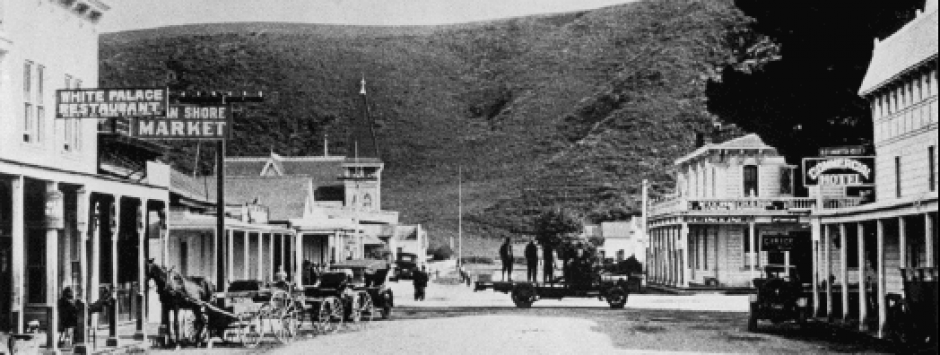
The Coburn murder, as you detailed in your excellent “Coburn Mystery” book, had a lot more mystery, and more wealth and power involved, and hence public interest and coverage, then this story. But, the events that were involved in this story, the murder of Harvey Green, stirred up the town enough that cries for a mass lynching were heard. The fact that a wellknown and well-liked Pescaderan, his wife, and three hired “gunsels” were all charged with the murder, caused people to take sides. The reality that the murder occurred in a shootout worthy of our TV-originated fantasies about how such things go down, with a Justice of Peace being present, gives us a detailed and fairly insightful look into this wild event in the frontier days of the Southern Coastside. A time when “We Don’t Need No Badges” was an unwise move on all parties’ part.
The story first appeared on the November 10th, 1873, issue of the “Sacramento Daily Union.” It was to be a year and a half before the court battles were over and justice was served, an unusual length of time in those days. Here’s the beginning. Enjoy. John
“A LAND TRAGEDY.— A dispatch dated at San Mateo, November 8th, gives this account of a fight about the possession of disputed property: A fearful tragedy occurred at Pescadero. About a year ago John Green and Charles Kinsey, proprietor of Lincoln Hotel at Pescadero. exchanged property. Green traded his ranch at Pescadero with Kinsey for land in lowa and other States. Upon Green’s going East he found that Kinsey did not own the land he represented to, and came back and commenced suit against Kinsey for damages, It also appears that Green’s wife had a homestead filed on the land at Pescadero; that she did not sign the deed, and on coming back went on her land and look peaceable possession of it four or five days ago, and was so living on it last evening, It is alleged that Kinsey hired a number of men, and together witb Mrs. Kinsey, they went last evening at 10 o’clock and attempted to oust Green’s family, take possession of the bouse or burn it. Green forbid tbem coming on the property and ordered them to leave. The attacking party, consisting of William Dow, Alexander McLean and Michael McLean, forced open the gate leading to the yard, and made a rush for the door. Harvey, Green’s brother, who was outside, they shot dead near the door. Green’s family inside, then opened fire upon the attacking party and drove tbem away. Dow and A. McLean were slightly wounded. John Green had one of his fingers shot off. Knowles, Justice of the Peace, hearing that there was likely to be a breach of peace, was on the ground before the attack commenced and tried to prevent it. They were all arrested soon after together with Kinsey, and sent to jail at Redwood City. This morning there is great excitement, and strong talk ot lymching some of the principal actors in the tragedy.”

Comments off

Joel Bratman: Travel Vicariously to Christmas in the Park in San Jose

To enjoy more of Joel Bratman’s images, please click here

Comments off

John Vonderlin: 1882/Coastside Inventors/Mr. Carter’s Wheat Cleaner

JohnVStory by John Vonderlin

Email John: benloudman@sbcglobal.net

Hi June,
This article from the April 8th, 1882, issue of the ”Pacific Rural Press,” reveals that George Carter, was not only a good writer, but a technically clever man, as well.
His farm at San Gregorio is mentioned often in the newspapers and this story is one of the reasons why. Enjoy. John

wheatcleaner

Wheat Cleaners.
The use of wheat cleaners attached to thrashing machines is becoming general, and farmers are demanding, more or less, that thrashers thrashing for them should use them. It will not be long before they will be as indispensable to a complete rig as the cook-house has become, owing to the system that is being rapidly perfected here to strictly grade all wheat put on the market. The result cannot but inure to the reputation of California wheat abroad, and we welcome them as great auxiliaries in elevating the standard of our wheat exports. With our best separators uniform cleaning cannot be had, owing to various causes—stopping and starting, changes in the motion, belts ilying off, dampness in the stack, etc., all make sacks more or less foul. Should the trier miss these foul sacks it would be all right; but somehow it seems to have a peculiar attraction towards them, and as the farmer watches the process, he declares: ” Well, I thought the machine was cleaning better than that.” Of course, the buyer grades down a dollar or two to meet this condition. Had the wheat been run through a good cleaner, every sack would have been up to full grade if the berry were good. Time was when the buyer made no distinction, looking only to the plumpness of the grain; but as such times are passing away, farmers will have to use more effort to put their grain into the market in good shape. While it is impossible to take out all the oats and barley, a good cleaner will make No. 1 shipping out of very foul wheat.
The advantages of a cleaner are not all on the side of the farmer, as it enables the thrasher to relieve his separator by using a coarse sieve, lowering the wind blast and let the cleaner do the rest of the work, thereby avoiding the one great trouble of blowing grain over the shoe into the chaff pile. We illustrate on this page a new wheat cleaner, the invention of Mr. G. Carter, of Byron, Contra Costa county, whose plant of thrashing machinery was illustrated in the Rural Press of date November 19, 1881. Mr. Carter used several of the cleaners now in the market laat season with his machines, but found them, as others have, so deficient and troublesome, that he set to work to make a clearer that would do his work rapidly and satisfactorily. In the construction of his cleaner he has aimed to overcome these troubles, and now offers to his brother thrashers, a cleaner which he assures us runs smoothly and quietly ; does not require constant attention to keep clean, nor half the crew to put it in position. It is built on the ordinary header gear, so it will keep in the road and handle easier than when the wheels are 8 feet apart. Zinc screens, six feet wide, with round holes are used. The elevator is placed in the middle of the back of the cleaner between the sills, instead of on the side. At the bottom of the elevator is a hopper with a slide gate into the elevator, which regulates the amount of feed to the sieves ; so that when a dump of clear wheat goes through the separator it cannot overload the sieves, and run good wheat over with the tailings ; the hopper holds it till it is gradually worked off. The elevator discharges upon a distributing board which distributes the grain evenly over the sieves, whether feeding fast or slow without any adjusting ; thence upon and through a coarse sieve, where it encounters a strong blast of wind; thence upon a slide which discharges it at the upper end of the series of zinc screens, and passing over these screens to the front, is discharged into the sacks. The discharge is high enough so that the grain spout used on the separator can be used on the cleaner. All the sieves, screens, and cleaning apparatus are in one shoe, supported by two springs on each side, driven by a cam movement of onequarter of an inch, with a speed of 600 revolutions per minute.
The cleaning is complete, rapid and saving, scarcely a kernel of wheat finding its way anywhere except into the sack where it belongs. The best principles of ” mill cleaning” have been applied to this cleaner in a light and compact form. The grain is conveyed from the separator to the hopper, with an auger driven by a simple device. Unlike other cleaners, it does not have to be built according to the side of the separator the parties intend to use it, (and after which they cannot be used on any other side), but it can be used on either side of the separator, whenever desired. In cleaning up the sheets about the sack-tender, they can be emptied into the hopper instead of taking them to the derrick. Steps have been taken to secure a patent on this device. Any farther information can be had by addressing the inventor, G. W. T. Carter, at Byron, Contra Costa Co., or M. C. Hawley & Co., S. F. The cleaners are being built at Jackson & Truman’s shops, in this city, where they can be examined by all interested.188

Comments off

John Vonderlin: On Gazos Creek & Other Place Names

Story by John Vonderlin

Email John: benloudman@sbcglobal.net

Hi June,
It would seem like that old newspaper article mentioning the Butano and Garzas Railroad Company, that I sent you from the February 18th, 1868, issue of “The Daily Alta,” may not be the final word on the origin of Gazos Creek’s name. While, that seems to be the earliest mention of the creek and the Garzas name for the creek, and it is in the incorporation papers for a Gazos Country enterprise, there is more to consider. First off, it’s also the last time, and only time, it appears in the record as far as I know. Secondly, just a year later, an ad in the May 24, 1869,  issue of “The Daily Alta,” uses the Gazos name. Interestingly the ad also mentions San Gregorio Creek, using the “o,” denoting the masculine gender in Spanish. There doesn’t seem to be a Saint Gregoria on a list of 5,000 on the CatholicOnline website, but Saint Gregory, who in life was Pope Gregory the Great, was very well known. Yet, often in the older references San Gregoria is the designation.
There are several other reasons that lead me to be unsure there ever was a Garzas Creek. Though in reality, at that stage of the Coastside’s development, the creek’s name was whatever people called it, with several possibilities possibly being common.
I have several leads and a couple of facts I wanted to verify about previous usages, but the Newspaper Archive website has indigestion or worse and is not usable today. So let me just list what I know;
In the travelogue article I recently sent you from “Pacific Rural Press,” issue of September 23rd, 1871, Garcia Creek was used to designate Gazos creek.
In Tess Black’s book, “Portraits of Pescadero,” on Page 145  it mentions that Gazos came from the Sea Gilly flowers that were growing there.
The February 18, 1868, issue of “The Daily Alta,” mentions the incorporation of the   Butano and Garzas Railroad company, using Garzas to designate Gazos Creek.
The May 24, 1869 issue of “The Daily Alta,” has a large professionally-prepared ad selling, The Chandler House, in which the Gazos Creek is mentioned.
In the “Sacramento Daily Union”  September 14th, 1870, issue, a notice is published that the Yazor Creek Canal Company was formed to build a flume in Gazos Canyon (Harvey Mowry’s book, “Echoes From Gazos Creek Country.”)
Then in the November 6, 1875, issue of the San Mateo Gazette,  they referred to the Garzos sawmill in the canyon (Harvey’s book).
Last and hopefully not least, is my theory that the Portuguese word for albinos, “Gazos,” is the source. I believe this because of several mentions in older references of the bare mountainside in this area being a landmark, both by sea and land. What seafarer, sighting “The Albinos”  as their dangerous voyage nears its end in the safety of San Francisco Bay, would ever forget them. I believe the “Albinos” was an early name for what is now called “The Chalks.” The Chalks is a high ridge on the western side of the Big Basin Park. It got its name from the light Santa Cruz mudstone and Monterey sandstone of which it is composed. This shows through in many places because of the relatively sparse vegetation. Several of the surrounding ridges are composed of the same material and are clearly visible from the ocean. That’s my story and I’m sticking to it, at least unil the Newspaper Archive stops Error messaging me. Enjoy. JohnOn

Comments off

John Vonderlin: 1871 “Super Spud”

Story by John Vonderlin

Email John: benloudman@sbcglobal.net

Hutchingsbook

Hi June,

I was thinking that the G.W.T.C. story might prove interesting and I was right. The following article about a “Super Spud” grown in San Gregorio, is just a fun filler for the pages of the “Paific Rural Press’s,” November 11, 1871, issue. But, the editors’ mentioning of Mr. J. M. Hutchings, led me to one of California’s earliest, and most charismatic chroniclers . I’ve located his, “Hutchings Illustrated California Magazines,” online at Archive.org. and would like to share the Coastside-related material. The magazines were noted for their many high quality wood engravings, and intelligent writing about the unusual spots around the State. The first story I want to share in the next email is about the Farallones, and it has both in quantity. Enjoy. John
Big Potato.
The following note explains itself:— Editors Press:—With this I send you a San Gregorio “Spud,” weighing 4 pounds and 2 ounces, and measuring 20 inches by 13—a single, perfect and well proportioned potato. If any one can beat this we would like to hear from them. It was grown on the sandy bottom land of the San Gregorio Creek, San Mateo Co., by C. Laudenslager, Esq. g.w.t.c.
(Ed.) This was a noble specimen tuber, and for the purpose of letting our Eastern friends see what California can do in the way of raising them, we gave it to Mr. J. M. Hutchings to take with him on his lecturing trip East. G.W.T.C.1871

Comments off

John Vonderlin: Pod People Will Be Head Over Heels For The Shoe That Fills The Bill

Story by John Vonderlin

Email John: benloudman@sbcglobal.net

Hi June,

It would seem to Mr. Carter, a regular correspondent to the “Pacific Rural Press,” that if Mr. Brown’s invention, a shoe, is used during harvest, that Pod People will be head over heels for it, or as he mentions, it is a shoe that fills the bill. I’m pretty sure that the Mr. Brown, mentioned as the inventor of the shoe to eliminate pods from oats when harvesting, was the original owner of the Willowside farm. He joins a select subgroup of Coastside inventors, those who produced inventions to refine and thereby improve the farming techniques locally.
This correspondence was in the September 19th, 1874, issue of the “Pacific Rural Press.” Enjoy. John P.S Mr. Carter writes well and seems to have a lot of interests. I think I’m going to see if I can find his life story.
How to Get Rid of the Pods.
Editors Press :—One of the greatest nuisances now overrunning the oat country in this State, is a weed bearing a yellow flower, and at harvest time presenting to the sickle of the reaper a cluster of poftß about the size of peas, and are cut and bound up in the sheaf. These pods, when they go into the sack from the threshing machine, damage the sale of the oats gre*tly, besides the sack room they occupy. If a machine could be had that would keep out these pods, the saving of sacks and increased price of the oats would equal the cost of threshing. It has long been the great desideratum of threshers and farmers to get a machine that would keep out these pods, but until tbis season without success, so far as I ‘have learned. The great trouble has been to get a shoe that would work a sieve with a mesh smaller than the pods without clogging, and admit of fast thrashing. I have been threshing many years at Half Moon bay and San Gregorio, and never succeeded in getting rid of the pods till this season, and am pleased to recommend a shoe that fills the bill exactly; Brown’s patent shoe of Pescadero. It is an end shake, consisting of an upper and lower sieve hinged together with a wide space of two inches between. Cams in the center raise and lower the sieve; at the same time it baa the end motion. Further description in superfluous. I have used it all season on the San Joaquin in foul grain, where everything went on the sieves; and as a rapid, handsome cleaner it had no equal. l am now using it on the Coast, threshing oats among the pod weed with satisfaction. It never clogs, and under fast threshing cleans the oats of all pods, thinties, joints and all rubbish that fills the grain fields in the moist portions of the State. I understand that the neighborhoods of Bodega, Tomales, Two Rock and Bloomfield are greatly troubled with the pod weed. If the threshers in that section will adopt these shoes, they will have no further trouble from the pests and prove a great thing for the farmers. They can be put in any machine, and are warranted to do the work as represented. I have no pecuniary interest in the patent and my only object in this letter is to call to it the attention ot all threshers who thresh amid foul grain, and all oat raisers that wish to be rid of the pods, and that the inventor may reap the reward due one who has put in our hands the means to do our work better and faster.
Several machines can be seen in this section at work. Any communication addressed to the inventor, N. M. Brown, Pescadero, will meet with prompt attention and a shoe put in at short notice. G W. T. Carter. San Gregorio, Aug. 26th, 1874.: P

Comments off

John Vonderlin: Fishing in 1872. Using “Giant Powder” to Catch Trout

Story by John Vonderlin

Email John: benloudman@sbcglobal.net

Hi June,

This article from the November 30, 1872, issue of the “Pacific Rural Press,” helps to explain why the fish were almost gone from the Coastside streams as mentioned in the previous article I just sent you. As they say, “Money doesn’t talk, it Swears.” If I had been a farmer near a creek I might have kept a double-barrelled load of Rock Salt ready to deal out my own little explosions of “Giant Powder.” The “Curse of the Commons,” where the greedy rush to get the last fish before somebody else does is an old story. It’s too bad flies, ticks and mosquitoes don’t taste good. Enjoy. John
California Trout.
The most delicious fish we have on this coast are our trout, and very
few streams will be found without them. In localities within reasonable
distances of the city, they afford great amusement for amateur Isaac
Waltons, and further off the Indians depend upon them for a portion of
their subsistence, and ranchmen vary their diet of bacon and beans,
or mutton, with an occasional dish of trout. The abundance of these fish
in most streams is, however, no excuse for parties to slaughter them
wholesale by the use of Giant Powder, or with seines. The former
method was extensively practiced until forbidden by law. Large charges
of Giant Powder were placed in a favorable spot in a creek and then
exploded. The concussion caused the fish to come to the surface,
where they were captured in large quantities.
The use of seines in almost as bad as this, and more especially when
used in breeding seasons. The law forbids the catching of trout during
certain seasons, varying in different counties of the State, and we
believe, expressly prohibits the use of seines in any instance;
nevertheless this rule is frequently broken. We know of an instance
where a gentleman in Marin County, after stocking a creek on his private
property with fish, at considerable expense, found to his chagrin that an
enterprising Frenchman had taken advantage of his temporary absence,
and had captured nearly all the fish in the stream by means of nets. If
this practice is allowed to continue, it will result in a total extermination
of our brook trout, much to the sorrow of legitimate sportsmen.
The Fish Commissioners have been very active in endeavoring to
suppress all of these nefarious practices, and we hope they will continue
to do so. A contemporary mentions an instance of wholesale destruction,
which only occurred last week, in which a two-horse wagon load of
salmon trout were caught in Pescadero Creek, with a seine. That particular
locality is one that should be especially guarded, since its close proximity
to the city renders it a favorite resort for sportsmen in the summer. It would
be well to see that all such creeks as Purissima, San Gregorio,
Pescadero, Butano, White House, Waddell’s, Scott’s, San Lorenzo and
others on the Coast, with which sportsmen are familiar, should have
some sort of supervision from residents near them, to prevent similar
depredations occurring there.
The trouble taken by many gentlemen in this State in pisciculture will be
more than counterbalanced by a few dozen men with nets; and while
some are endeavoring to stock new creeks with fish, others will be
emptying the inhabited ones by means unbecoming sportsmen. There
are so many people who delight in angling that it is a pity that their sport
should be stopped to satisfy the pecuniary desires of a few “pot-hunters.”
If every farmer who lives near a creek which contains these finny beauties,
were to keep an eye on the people who they see in the neighborhood,
and would report to the Fish Commissioners any violation of the law,
these offences would be much less frequent.

187

Comments off

John Vonderlin: (1871) Pescadero is a “paradise” compared to HMB

Story by John Vonderlin

Email John: benloudman@sbcglobal.net

Hi June,

This is from the January 21st, 1871 issue of the “Pacific Rural Press.”  Pescadero in relationship to Half Moon Bay is a Paradise? I guess HMB was just too much of a big city for Mr. Herring. Or maybe Mr Swanston (sic) gave him a few free beers.
I assume  they were talking about the Pigeon Point Wharf in the article.  Enjoy. John
AT PESCADERO
There is an excellent settlement, and the place, in contrast with Half Moon Bay, is a paradise; and any word but praise would be mis-spoken, when referring to Pescadero, although there is still chance for improvement there, and they are improving. The farms are fenced, the houses painted, the front yards planted with trees and shrubbery . the homes pleasant and business flourishing. A new wharf is in contemplation, when shipping will be facilitated and the rates of freight lowered. There is now a monopoly that charges exorbitant rates to San Francisco. The mountains, back, are tilled with excellent timber, and several saw mills are already at work; while the soil is very fertile and productive. The best hotel on the coast is here, kept by a gentleman who knows how to do it, and does it too, Mr. C. W. Swanston(sic). Pebble Beach, near here, is one of the attractions that draws a crowd in “the season.” Between Half Moon Bay and Pescadero there are several stations where business is, or may be, good, according to the disposition of the inhabitants, which are mixed. Taken all in all, this section of California is the most varied, the richest in soil, entirely independent of drouth,(sic) and the finest “in the rough” of any we have seen. S. H. Herring.

Comments off

John Vonderlin: Miles J’Anson writes about Pebble Beach in 1888

Story by John Vonderlin

Email John: benloudman@sbcglobal.net

-1

Hi June,
This article from the June 2nd, 1888 issue of the “Pacific Rural Press,” is the most extensive, information-filled article I’ve seen on Pescadero’s famous Pebble Beach. Written by a Mr. Miles J’Anson, it is the only article I can find by him in any source I looked at. That’s unfortunate as he has a wonderful vocabulary, even though his spelling and facts are not always as good. Some unusual words, useful to know, in the article are:
silicious, (siliceous) silicon based minerals, esp. the quartz family
pullucid, (pellucid) clear, permitting light to pass through
umbrageous, affording shade
linnet, small passerine bird in the finch family, a songbird
susurrus, a whispering or rustling
turquoise, a hydrous phosphate of aluminum and copper that wasn’t at Pebble Beach and is not a siliceous mineral
“water drops,” minerals, in this case quartz, that have liquid inclusions. They are not really that rare, but he is right, in that generally the included water is that which was there as the mineral formed, sometimes billions of years old. Because of this they are an important research tool.
General Dimond, noted capitalist of San Francisco, see headlines below from his death announcement
Long Branch, probably the famous New Jersey beach of that name, (note N.J. by Miles’ name) and not the “Gunsmoke” saloon Miss Kitty ran.
sea-marge, land that borders on the sea
arenaceous, sandy
vug, small cavity in rock
Amphitrite, sea goddess, wife of Poseidon
aquaria, aquarium
Woodbine, various climbing vine, esp. Mediterranean honeysuckle
Pebble Beach, Pescadero, California.
A Sea Beach on the California Coast Remarkable for Silicious Gems and Mineralogical Curios.
[Written for the Press.] Officers of the coast survey have characterized the famous Pebble beach of Pescadero as one unque of its kind and without a counterpart on the whole extent of our Atlantic and Pacific coastlines. Its distinguishing feature is the mass of highly polished, pure silicious gravel bordering the sea at this locality, in which the topaz, carnelian, onyx, chalcedony, turquoise, agate and jasper pebbles are found, buffed and perfected by ages of wave action as if by a lapidary.
Wave action has also eliminated all soft and angular minerals from the mass, save occasional fragments of abalone shell and chalcedony, and only the hardest stones survive the surf’s eternal attrition.
Many of the topazes and carnelians are of rare clearness and beauty, and may be matched by patient search in size, form and color for jewelry, or for display in mineral cabinets.
Some fine pebbles of milk and fire opalescence are found; and the surf-polished crystals of pure, pullucid (sic) quartz gleam like dewdrops in the multi-colored gravel. The cornelians (sic) are of all tints, from blood red to the palest pink or purple; and in some rare specimens the color is singularly confined to the middle of the stone, while the exterior is perfectly limpid.
Here, too, are found agates of every color and combination, the choice of which make handsome bracelets, watch-charms and other personal trinkets when cut and set. The smaller gems, however, of clear tint, perfect form and suitable size need no touch of art or lapidary’s wheel, but in their natural state, set in contrasted colors, are jewels at once unique and of special interest. Stones of this class are generally small.
But chief among the mineral curiosities of the beach are the so called ” water drops,’ which are most abundant on a piece of sea-marge north of the main deposit, known locally as “agate beach.” These are chalcedony pebbles, more or less translucent, and usually about the size and form of a lemondrop, having a globule of water imprisoned in a central cavity, and an air bubble which, when small, looks dark by transmitted light and moves within like a living insect. They are highly prized and much sought after by mineral and curiosity collectors. Mrs. General Dimond of San Francisco is accorded the credit of being first to discover and direct attention to these curios of the beach.
To the non-scientific the stone-imprisoned water is a mystery not less puzzling than the milk in the cocoanut. If it had percolated from without it should be sea-water; on the contrary it is perfectly fresh. The explanation is that the aqueous drop was enclosed by the silica during the process of crystallization. These curios, though rare, are not unknown in other parts of the world; and they are occasionally met with in the vugs or cavities of quartz veins during mining operations. It is evident, however, that only under exceptional conditions of temperature can they exist on the surface of the earth as at Pescadero, since either a temperature below 30° would freeze, or powerful sun rays would expand the water within and fracture the silicious bulbs. On other sea-beaches washed crystals of smoky and limpid quartz occur; such crystals are plentiful at Long Branch, but I found there no other varieties worthy of note, and though many of these are beautifully clear while wet, they lose their limpidity when dry, owing to forcible impact one with another in the strong surf, which, as microscopic inspection shows, oovers their surfaces with minute fractures. At Pescadero, however, the silicious gem material occurred in extraordinary variety and profusion; the sea floor and beach contour favored accumulation and a gentler attrition, and we have therein the fine lapidary finish of these lustrous stones the ultimate product of patient Nature and the tireless sea toiling through untold lapses of time.

-2

Pebble gatherers are enthusiastic in their pursuit, aud return again and again to the charmed precincts of the beach for new varieties, more perfect specimens, or to complete “sets.” And surely no hobby could be more innocent, more full of restful enjoyment and physical good than the gathering of these pleasing and imperishable mementoes in the exhilarant sea air and climate of the Pacific Coast, and in so delightful a locality. But beyond its distinguishing feature, the Pescadero beach is otherwise interesting and picturesque. The receding tide leaves wide stretches of kelp-covered reefs, where fine sea-mosses and the beautiful abalone univalves may be obtained by the more adventurous visitor. Here, also, are things of interest to geologist and naturalist in the lithology of the shore, the fantastic carving and surf sculpture of the rocks, the pebble-paved pools and basins in the uncovered sea floor, hollowed as if by art, fit baths for the sea nymphs, or fabled Amphitrite, and natural aquaria rife with varied sea life, lined with mosaics of purple-spined sea-urchins, limpets, and many-tinted sea-anemones.

-3

The botanist, too, especially one unfamiliar with the California flora, will find much of special interest in the wildflowers, grasses and shrubs of the immediate coastline, if he times his visit rightly, say in the period between March Ist and the close of July. There is for the angler fairly good trouting in the Pescadero river, which rises in the higher Coast Ringe and courses through the village to the sea. But, better fishing may be enjoyed in several fine trout streams a few miles southward; and in the grand redwood forests east of the village, hunters and summer parties can find unrivaled retreats and camping grounds.
The Beach and the Pebble Seekers.
A mile in lineal extent north and south will embrace nearly all of the Pescadero beach deposit; and “Pebble beach ” proper is but a part of this, a crescent-shaped sweep of sea marge sheltered between rocky promontories and backed by arenaceous bluffs. Around this crescent, on the seaward slope of clean, surf-washed and sun-warmed gravel, lie the pebble gatherers in all postures of ease, singly and in groups, sorting with unflagging interest the bright colored mass, and dropping their selections into wide mouth bottles, cigarboxes, or muslin bags made for the purpose. Here is one who, with the indiscriminate zeal of a neophyte, finds lovely things on every hand, and speedily fills her bottle, her handkerchief, and other improvised receptacles with clear and many-colored stones, gems all, to her untrained eye; but here is another assiduous seeker more advanced in pebble culture, whose critical taste discards all but the perfect in color and form, and whose little vial happly holds all the gleanings of patient hours. A smoke rises on the beach and a call is heard. This is the welcome signal that lunch is ready; and what an impromptu and enjoyable affair it is truly! Here is gypsying under most charming conditions! A campfire has been built from seadrift, and a tablecloth covers a flat-topped log, upon which cups and plates are arranged; the coffee is hot, and the sandwiches, eggs, cheese, cold meats, cakes, pies, etc., with which the baskets were bountifully filled by our hostess before leaving the hotel, are ready for appetites made keen by the pulse-stirring drive to the beach, the bracing seabreath and the stimulus of genial rivalry in a common quest. Formality is banished, and all the hotel guests, though but chance met today, mayhap eat and chat with refreshing unreserve together, after which the various finds are shown and compared; but briefly, as the fortunate are eager to renew the search, and the less lucky are inspired with new hope on seeing the “beauties ” found. The village of Pescadero (formerly a Spanish fishing settlement, as the name implies) lies out of the beaten tracks of tourists and traffic in a picturesque little valley, through which flows the Pescadero river, a limpid, mountain trout stream, the ideal ” brook ” of Tennyson’s poetic fancy. It is nearly midway on the coast between San Francisco and Santa Cruz, and the nearest railway stations are at San Mateo and Redwood, from which points, and also from Santa Cruz, daily stage connections are made. The best route is from San Francisco by the Southern Pacific railway to San Mateo; thence by stage of a very picturesque section of the Coast Ringe, passing through Spanishtown (Halfmoon Bay) and the ranches that border the sea, an enjoyable and typical California stage coach ride of 30 odd miles. But the outward trip from Pescadero by coach to Santa Cruz is a scenic treat of yet more delightful and varied character, and the traveler in alternately whirled through the foamy beachsurf of the Pacific, under cliffs, and over steep mountain buttresses, through sequestered ranches, hamlets and forest solitudes to California’s greatest seaside resort; and from there through the grand redwoods and rugged scenery of the Coast mountains by the serpentine Narrow Guage (sic) R. R. to Oakland and San Francisco. The famous beach is two miles from the village, and there are no houses or accommodations for sojourners nearer thereto than the Swanton House. Parties with camping outfits pitch their tents on the bluffs near the shore; but the hotel guests and villagers, according to ability or inclination, either walk to and from the beach, or go down in staging parties, which are usually made up in the morning soon after breakfast. Pescadero is not a rendezvous of fashionable folk, nor a watering place in the usual sense; but it is a place of special attraction to anglers, hunters, campers, tourists and a cultured class whose tastes lean not to crowds and display; a favorite resort of many San Franciscans who periodically fly from the city’s rout and turmoil for a term of restful change, and a spot of memorable charm to all who find joy with Nature in forest and stream, on mountain and beach, and who love the luxury of “old clothes ” and the freedom of an unconventional life. Good accommodations at reasonable rates are furnished at the Swanton house, a comfortable, unpretentious hotel with a number of detached one-story cottages for families and others desiring to dwell together. These are bowered in roses and climbrng vines, and front a pretty garden where flowers bloom almost perennially among a profusion of shrubs, exotics and shade trees that never know the blight of winter frosts.

-4

It was from this umbrageous haunt of birds that on the odorous morning air came to my waking ears the ecstatic song of the California linnet from whose mellifluous throat, after a preluding “chic-chic,” poured helter-skelter a marvelous maze of liquid syllables—a carol as sweet and joyous, surely, as ever bubbled from bird heart to greet the rising sun. And between these impetuous rhapsodies, blending with the susurrus of Woodbine and acacia leaves, came dreamily to the sense the faraway lullaby of sea-murmurs, borne up from the estuary where the surf toils with the outflowing waters of Butano creek and the Pescadero. Strangers on the Pacific Coast are often troubled with the Spanish nomenclature there prevalent. The correct pronunciation of some familiar California names can be learned by attention to the rhyme and measure of the following jingle:
A man named Mayo
Came from Vallejo (-layho}
To San Mateo
One summer day.
Inquiring ” Where, O,
Is Pescadero?
And what’s the fare, O,
To San Jose?” (Hozay)
Miles J’Anson. Woodside, N. J., May 7, 1888.

Comments off

John Vonderlin: Pescadero’s Pebbles make good poetry

Story by John Vonderlin

Email John: benloudman@sbcglobal.net

-1

Hi June,
This is a poem by Minot Judson Savage, from his “America to England” book of poetry published in 1917. It is viewable at Archive.org. I’ve attached an excerpt from Wikipedia about Mr. Savage, that explains how an East Coast minister happened to publish a book with a poem about Pescadero. He might very well have been talking about Invisible Beach in his last few lines.

The Pescadero Pebbles

WHERE slopes the beach to the setting
sun,
On the Pescadero shore,
Forever and ever the restless surf
Rolls up with its sullen roar.

And grasping the pebbles in white hands,

And chafing them together,
And grinding them against the cliffs
• In stormy and sunny weather,

It gives them never any rest :

All day, all night, the pain
Of their long agony sobs on.

Sinks and then swells again.

And tourists come from every clime

To search with eager care
For those whose rest has been the least ;

For such have grown most fair.

But yonder, round a point of rock.

In a quiet, sheltered cove.
Where storm ne’er breaks and sea ne’er comes,

The tourists never rove.

Comments off