From June: Collected from various newspapers and written in pen and ink on pink lined legal paper. Yes, pre-Internet, that’s what I did. I either copied articles by hand or copied them if that was possible.
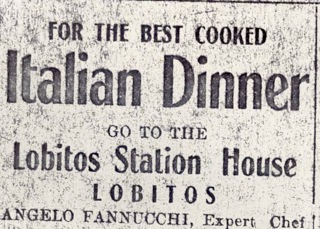
December 1899: Dr. Davis, the popular dentist, is at the Swanton House. Swanton House management will soon change and an Italian will be the new manager.
———————-
March 1, no year. [This story appears to be written in haste….]
From the Call Bulletin. Santa Cruz.
Stage Topples Into the Sea
Wave Carries Disaster to the Pescadero Coach
20 miles up the coast the stage roads along the beach, which at high tide is often covered by water. Yesterday the ocean was higher than at any time in 35 years.
When driver James Harvey reached this point a monster wave dashed against the stage and captured it.
For two hours the horses, Harvey, and his single passenger, William Steele, floundered in the cold water of the Pacific. Both men are good swimmers. The horses were cut loose and found their way to dry land. Help arrived and after several hours the stage was turned over. The iron rim around the hub struck the rocks with such a terrific force that it bent like tin…..
Posted inPescadero Trivia|Comments Off on Pescadero Trivia….The dentist visits & a monster wave captures the stage
Here’s a bit of silliness about something I’ve never witnessed before. It’s funny how a pod of beached whales, slowly dying in a hostile environment, will bring out hordes of volunteers attempting a rescue, many with tears in their eyes. Yet the same situation, multiplied many times over if it involves snails, is invisible to our hearts, or even worse, produces a darkly humorous view of the matter. Or is that just me? Still suffering from the trauma caused by these vicious predators when I was an avid gardener?
Hi June,
A while ago I posted about the Cowell-to-Purissima Bluff Trail that P.O.S.T. was having built on their property south of the Ritz Carlton.
I recently read that financial problems have stopped the project before completion. When the opportunity arose, I visited both ends of the project and was able to see that the parking lot, the wide, all-weather path, the southerly bluff overlook, and the fencing protecting the farm fields, all seemed to be ready. Apparently, though it’s hard to tell from afar, the three bridges meant to span the small canyons along the path are not doing that. When this will change, I don’t know.
I also viewed another sad situation that day. It’s a tragic tale of a massacre, precipitating a desperate diaspora of the traumatized or injured survivors. A headlong flight that left them in a hostile environment; without food or water, vulnerable to predators, broiling in the sun, and with nowhere to go for succor.
Fortunately, these victims are just common garden snails, often objects of such contempt that they are stepped on just for the pleasing sound the pop of their shells produces.
But, even I, who has been known to play a form of baseball with his siblings using snails as the projectiles, upon viewing their plight, was moved to compassion, in thought, if not deed, by what I saw. Though, I must admit the E word (escargot) might have been intemperately used in jest.
The morbidly curious, or extremely insensitive, or just plain hungry, who are willing to walk out to the Cowell Beach Overlook path, can also view this odd event. It first came to our attention when I noticed a shiny substance on several plants’ leaves alongside the path. Peering closely, I opined that it looked like snail slime, even though that was unlikely, as this is not real snail territory. It’s dry, rocky soil, with unfriendly looking low weeds, most of which had rough, spiny leaves, bound to irritate the fleshy, softness of a snail’s foot.
Noticing the ubiquitousness of this strange substance on nearby low shrubs, I began to investigate.
I started riffling the leaves of a small bush with some of the shiny substance on it and discovered a common garden snail. Ahhh. Mystery solved?
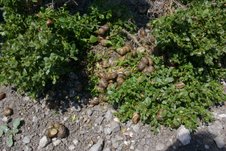
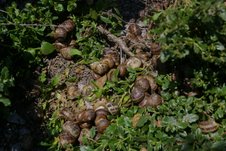
To be sure, I started looking around and apparently the snails had decided we were harmless, because they dropped their cloak of invisibility. Suddenly, they were everywhere. I could see them, alone, hanging from the weed’s lower branches, bunched in groups at the stalk’s base, even clustered at the top of metal poles like dead, brown Brussels sprouts still on the stalk in an abandoned field. There were thousands of them. Check this picture of a small bush: When I shook it, fifty snails dropped to the ground.
Such large numbers of snails, left to survive in such a hostile environment, made no sense. Even in the most snail friendly environment, I’ve never seen such numbers. Was this some ecological oddity? Or another harbinger of global warming? Was a tsunami wave of snail infestation heading toward the hapless gardens of Half Moon Bay?
Probably not, (as you can see in some of the pictures I’ve attached) the field in the background was being prepped for planting. I believe that was the cause of this diaspora. With their Fava Bean homeland destroyed, those not immediately killed in the massacre had fled for their lives to the much drier strip of vegetation on the side of the field.
I saw a number of snails that, despite parts of their shells cracked, had crawled to the relative safety of this sun-baked, barren strip. Checking across the path, I was able to find a few who, disturbed by the crowded conditions of their refugee camp, had ventured into the even drier, weedy wasteland nearby.
That clinched my faith in my analysis of this strange scene. Whether the Endangered Species Act applies to this “rare species of snails,” endowed with the power of invisibility, I don’t know. But, if I could get a grant, I would be glad to go there and rescue several five- gallon buckets of them. I’d bring them home, get them back to good health with cornmeal, and spritz them regularly. Then I’d release them in a far, far better place then they’ve ever been before, a savory Land of Milk and Honey, sometimes called Garlic and ButterLand. Enjoy. John
The Classic Story of the Levy Brothers: The Finale
The answer is YES, it turned out that the third Levy, Adrien, and Josephine’s sister, Emma, were a perfect match and wed soon after meeting.[Makes you think of eHarmony, or one of those love match sites, doesn’ tit?]
There was one more Levy brother left, Armand. This time it was Emma and Adrien who conspired to bring Armand and Josephine and Emma’s sister, Natalie, to Half Moon Bay, where they felt certain another marriage would take place. And it did.
Now all the Levy brothers were on the Coastside and Josephine had her siblings as close companions. To complete this perfect family picture, each of the Levy’s wives bore three children each.
The brothers started out in the general store business but now they wanted to expand into areas they knew less about, always a challenge but a challenge often armed with the unexpected “black swan” kind of surprises. It sounds good but you just don’t know what’s going to happen and when.
They got into the stagecoach business by buying Andrew Taft’s line, including the often rough-and-tumble drivers. Perhaps their name was stamped on the side of the stages, advertising the chain of stores, I am not sure because I have not seen such photographs but it makes sense. The stage probably carried their dry goods, the mail, and of course, the passengers, who, in Half Moon Bay, stayed at the Occidental Hotel.
The newly arrived brother, Adrien, felt the real estate bug, and with his brother’s support bought 3,000 acres near Pomponio Creek. That was about 1900. They may have been going in the wrong direction when they tried to revive whaling at Pigeon Point, but whale oil was often used for light and Pescadero did not get electric lighting until the mid0 1920s. To work in the dark, you had to have lanterns or some way to get light, and the lack of it was a real problem.
Part Vi (finale) Next
The Levy Brothers were branching out into new businesses, including a sawmill on Butano Creek, employing two dozen men. As a mechanical cream separator revolutionized the dairy business, the Levy’s invested in Coastside creameries and cheese factories.
According to old newspapers, 600 cows were put to work at a factory at Pigeon Point. Another cheese or cream factory stood north of the old Petersen & Alsford store in San Gregorio. The third occupied the site once used by a water-powered grist mill on Pilarcitos Creek in Half Moon Bay.
In many ways, the Levy Brothers symbolized the ways in which American businesses expanded—sometimes successful when they moved away from their specialty, sometimes headed for black holes.
Their investments sounded like they linked together well: general stores, stagecoaches, real estate, creameries and sawmills. They had their fingers in a lot of possibly lucrative pies.
About the same time they also leased a much larger space for their Half Moon Bay general store on Purisima Street. Three times larger than the old location.
But their thirst for more outside investments wasn’t satisfied, and they looked to the Peninsula for more places to put their money. They were intrigued by plans for the extension of an electric trolley service from San Francisco to San Mateo (where their stage line could pick up passengers, or were the brothers hoping to extend the trolley to Half Moon Bay and south along the Coastside? The trolley was a giant step beyond the stagecoach.) While exploring new possibilities, the Levys also decided to open a new store in San Mateo. Now they had a chain of four stores.
Living on the sunnier Peninsula helped convince them that that would remain their permanent home. About 1902 ads appeared in newspapers announcing that all the Coastside stores were for sale, including the land near Pomponio Creek.
Many decades later, around 1972, descendants of the original Levy Brothers opened a clothing store in Half Moon Bay, next door to the present day location of the New Leaf Community Market. This time their stay was shorter than in the 19th century and in the blink of an eye the store closed, leaving one open in San Mateo, which also closed in the late 20th century.
The answer is YES, it turned out that the third Levy, Adrien, and Josephine’s sister, Emma, were a perfect match and wed soon after meeting.[Makes you think of eHarmony, or one of those love match sites, doesn’ tit?]
There was one more Levy brother left, Armand. This time it was Emma and Adrien who conspired to bring Armand and Josephine and Emma’s sister, Natalie, to Half Moon Bay, where they felt certain another marriage would take place. And it did.
Now all the Levy brothers were on the Coastside and Josephine had her siblings as close companions. To complete this perfect family picture, each of the Levy’s wives bore three children each.
The brothers started out in the general store business but now they wanted to expand into areas they knew less about, always a challenge but a challenge often armed with the unexpected “black swan” kind of surprises. It sounds good but you just don’t know what’s going to happen and when.
They got into the stagecoach business by buying Andrew Taft’s line, including the often rough-and-tumble drivers. Perhaps their name was stamped on the side of the stages, advertising the chain of stores, I am not sure because I have not seen such photographs but it makes sense. The stage probably carried their dry goods, the mail, and of course, the passengers, who, in Half Moon Bay, stayed at the Occidental Hotel.
The newly arrived brother, Adrien, felt the real estate bug, and with his brother’s support bought 3,000 acres near Pomponio Creek. That was about 1900. They may have been going in the wrong direction when they tried to revive whaling at Pigeon Point, but whale oil was often used for light and Pescadero did not get electric lighting until the mid0 1920s. To work in the dark, you had to have lanterns or some way to get light, and the lack of it was a real problem.
Then came the weddings. Joe married Hannah Walker , whose dad owned Walker’s Drug Store in Half Moon Bay. Fernand took his time finding his soul mate, finally returning to France where he found, Josephine, the woman of his dreams. According to legend, it was a romantic proposal with Fernand on his knees between scenes at the opera house.
But guess what? Josephine turned him down.
She expected Fernand to observe European tradition and ask her parents for her hand first. He tried to explain less formal American views on marriage but she would have none of it. Fernand returned to Half Moon Bay alone but the image of Josephine loomed large in his mind. He couldn’t forget the rejection and he returned to France and tried once again. I don’t know if this time he went to her parents, but Josephine accepted the proposal with a strict condition: that they live on the Coastside temporarily and return to France as soon as possible.
I imagine Josephine found it tough living in rustic Half Moon Bay in 1883. That same year her new husband and his brother bought a third store in from now Supervisor John Garretson in Pescadero. Thirty-year-old Joe was in charge of the Pescadero store, and he moved his family into the old, famous Swanton House, an easy walk to the former Garretson & Mattingly Mercantile across the street.
By now Joe had had a dozen years of experience, and he was Pescadero’s leading merchant. One story credits Joe with “pioneering the inland market.” He’d ride to very remote farms on horseback, bringing a couple of pack mules with him, to hold dry goods which he’d sell back at these faraway farms. This saved the farmers a long trip into town—and appealed to the women, who lived far from town, who enjoyed the “luxury” of shopping from home.
Joe hired employees, and he had a popular one in J. C. Williamson, who wore “different hats” as the store’s druggist, telegraph operator, and he finally also became the postmaster, a prominent job that Joe originally held. J.C.’s personal popularity and ambition led him to open a competing store a couple of years later.
Just imagine what that moved stirred up in the little town of Pescadero!
Meanwhile Fernand, in Half Moon Bay, had to deal with his wife, Josephine’s loneliness in a town where she no family or friends, and felt out of place. But she was a smart woman: she convinced sister Emma to come from France and stay with her on the Coastside. Coincidentally, the Levy’s third brother, Adrien, had sailed for Half Moon Bay to join the enterprising Levy Brothers.
Was that part of the resourceful Josephine’s plan to resolve her loneliness? That sister Emma would meet brother-in-law Adrien and fall in love?
Soon the “credit squeeze” was felt by the Levy’s, who as businessmen were vulnerable to the ups and downs of the financial markets. They had been selling on credit to the farmers who had suffered through a drought and had no crops to sell to pay off their debts.
They could have closed the store but instead young Joe Levy rode to San Francisco to meet with the brusque Daniel T. Murphy [of Murphy & Grant], a dry goods wholesaler. To the more financially successful Murphy, Joe explained he needed an immediate loan or an extension on money owed.
Dan thought about throwing Joe out of his office, until Joe said he was thinking of writing his father in Europe for a loan, where, apparently, the financial “panic” had not been felt.
That turned the tide for Joe; When Dan Murphy heard that Joe was willing to ask his family for a loan, he was impressed enough to give him what he was asking for.
By the end of the 1870s, the financial markets had come back, and with the turnaround, Levy Brothers prospered—so much so that they opened another general store beside a popular saloon on what was then the main road, this one located in the tiny, beautiful farming community of San Gregorio. Fatherly Fernand opened the store and was appointed postmaster.
The little community of San Gregorio supported a schoolhouse, a Chinese “washhouse” in the part of “town, ” populated with homemade shacks known as Chinatown.
The Temperance Movement (anti-saloon, anti-alcohol) was alive in San Gregorio where its members attended meetings at Kineer’s Hall.
How did they get the merchandise for the store in Half Moon Bay? Once a week Fernand or Joe jumped into a “spring wagon” with a team of horses and left home at 2 a.m. for the long journey to San Francisco. He had to leave extra early to be there in time for the early produce market opening, obviously to augment what he must have bought from local farmers. He also visited the nearby wholesale houses
His direction was eastward, over the untamed mountains, following the stage route near present day Highway 92. Where there once was a valley with a few farms, now filled with water and known as Crystal Springs Lakes, the Levy’s wagon turned a sharp north toward the place where the sand dunes were being replaced by a growing population.
Twenty-four hours, the wagon from Half Moon Bay returned filled to the brim.
The Levy brothers were loveable in a town where it might take a little longer to be loved. Maybe it was the accents, the charm, their oh so recent connection to Europe, the “old country,” where the culture was distinctly different from that of the newer, eartheir America.
Of the pair, Fernand was the eldest, endowed with the fatherly touch; Joe was a humorous guy who always had a joke in his back pocket. Sometimes he went farther like the time a salesman bent down to pick up his suitcase and found it wouldn’t move in any direction. Funny man Joe had nailed it ot the floor.
Whatever it was, they possessed a magical kind of charisma. The brothers knew how to deal with their employees so that internal beefs were settled amicably and fairly. It’s ok to ask: Was this just a fairytale?
The store became profitable very fast and Fernand and Joe thought about opening similar stores on the Coastside. Then came the “Panice of 1873” and money was tight, paralyzing the economy. The expansion plans were put on hold as the newspapers reported major businesses shutting down and declaring bankruptcy.
The hardworking farmers, who accounted for most of the Levy Brother’s business, suffered the most from the “Panic of 1873.” Those who lived farthest from town paid debts once or twice a year after selling their crops. But when bad weather, in the form of a long drought, hit, well, in some cases, they had no cash at all. Many solved the problem by running away (which also makes it hard to track down early Coastside settlers.)
Note: The San Mateo County History Museum located in the Old Courthouse in Redwood City has many vintage photos of the Levy Brothers as well as documentation.
An old-new story by June Morrall
The “Classic” Story of the Levy Brothers
(Time: Late-ish 19th century)
Before help arrived to squelch the hot flames, an out-of-control blaze had engulfed Charles Kelly and Richard Mattingly’s” General Store in Half Moon Bay. The fire spread to engulf nearby M.E. Joyce’s Saloon, and eyewitnesses sadly predicted that they would lose one of the only places to shop for supplies.
Without an official fire department, the town’s citizens formed bucket brigades, perhaps scooping up the cool water from Pilarcitos Creek where the famous concrete bridge built in 1900 welcomes visitors into town today.
As the fire burned itself out, you can imagine how store owner Charles Kelly, described “as a power in local politics,” felt staring at the remains, a charred shape of black rip rap. But on that terrible day both he and partner Richard Mattingly said they were going to rebuild an even bigger building, two stories, 25-feet wide, with the ground floor leased to Wells Fargo Express, the post office and recently installed telegraph services from San Mateo-Half Moon Bay and Pescadero—but then 12 months later the owners threw in the towel, and put the store up for sale.
Through friends, two young brothers, Fernand and Joe Levy, recently arrived from France, learned about the business for sale and snapped it up. I don’t know where they were living at the time but it was Fernand and Joe’s dream to own a store in a small town. They came to see Kelly and Mattingly’s business in 1872, a year when there was lots of loose talk of railroads connecting the Coastside to the buzzing city of San Francisco.
Had any of these plans come to fruition, Half Moon Bay would have been the economic winner, selling wood from local sawmills for the construction of new homes in the growing city to the north. The Coastside’s vegetables, famous for their freshness and “enormous size” would have filled the marketplace.
I’m sure that Joe and Fernand were highly aware of the possibility of a railroad, any railroad, and like other ambitious businessmen, believed it was going to happen. With little thought of the reverse, that is, no railroad, the Levys purchased Kelly and Mattingly’s business.
Both Levys possessed pleasant personalities and were easy to be around. From the moment they opened the new doors, the brothers stocked a variety of merchandise and groceries, “intended to startle the natives,” according to a newspaper report.
In front, on the street, there was a display of the latest plows and mowing “machines,” and inside the dry goods included clothing—a genuine general store, said to be one of the first of many business ventures launched on the Coastside.
A while ago I posted some excerpts from the old history books that seemed to lean towards Dennis Martin constructing the first sawmill in San Mateo County, rather then Charles Brown, who is credited by many. Both are credited as possibilities on the plaque on Portola Road, commemorating the first San Mateo sawmill. One account I shared even had somebody else building the first mill on Brown’s property and leasing it from him. Well, here’s an article from the “Call,” that seems to add another possibility.
Bill Pease (Peace?) is acknowledged in the other accounts as being the first sawyer, but only as a hands-on kind of guy, without a sawmill. This article seems to state otherwise. It is from the March 1st, 1889, issue of the “Call.” Enjoy. John
P.S. You’ll notice this came up on an “Isaac Graham” Search. He has a lot of connections to interesting people, and events, sometimes not so pleasant connections, but often colorful.
PIONEER SAW-MILLS. Early Methods of Making Timber of California Redwood.
Pacific Coast Wood and Iron
In the early history of California all the lumber required for the use of its inhabitants, not a great deal, was gotten out with the whip saw and tbe axe, the thinner boards being manufactured with the saw, while the planks, beams, etc., were first split out and afterward hewn into the desired shape. As most of the lumber then used was made from the redwood, the manufacture of the coarsest kinds was an easy matter, owing to the facility with which that timber rives. The first sawmill in the country was put up at Santa Cruz by Isaac Graham, in 1843. It was driven by water, and though of limited capacity, was able to meet all the requirements made upon it. Such a contrivance for cutting lumber greatly astonished the natives, who had never seen anything of the kind before. Though all talked about “la maquina” and wondered at its performance, it excited neither jealousy nor opposition, the. ease-loving Californians being only too glad to avoid the laborious task ol getting out lumber by the old methods. The extra wages paid lumbermen were not with them so much an object as a decent excuse for shirking hard work altogether. And so this pioneer sawmill proved a good thing all round: Isaac Graham made money out of it, while los wvaqueros, through its operations, were relieved from tbe irksome toil of making lumber with the whip-saw, the beetle and tbe axe.
In the fall of 1845, Captain Stephen Smith, of Baltimore, put up a sawmill on Bodega Bay, this being the second one erected in California. Captain Smith had been on this Coast before, having arrived here first in the month of May, 1841, bringing his vessel around Cape Horn. Visiting Bodega Bay at that time, and noticing the fine timber growing in the vicinity, it occurred to him that a good opening offered there for cutting lumber for the use of the Russian settlement near by, for the settlers in Sonoma Valley, and for the San Francisco and other markets further south. Returning to Baltimore by the Isthmus of Panama, he brought out on his return trip machinery for a steam sawmill, as well as a steam flouring mill, both of which were set up on the shores of Bodega Bay, the latter being used for grinding the wheat raised at the Russian settlement at Fort Ross. In connection with this enterprise, Captain Smith obtained from the Mexican Government a grant for eight leagues of land lying adjacent to the bay, much of it well timbered with redwood. A little later in the same year. General Vallejo built a sawmill in the redwoods six miles above the town of Sonoma. A good deal of lumber was made here, the occupation of the country a year later by the Americans greatly increasing the demand for this article. The following year, James Peace (sp?) built a sawmill at a point about twenty miles south of San Francisco. It was located in the redwoods in the southern part of what is now San Mateo county. Then followed the Sutter-Marshall mill, erected in the fall of 1847, on the South Fork of the American river, where stands the town of Coloma, or rather, where it did stand, for it is now nearly all washed away…..
Posted inJohn Vonderlin, Sawmills|Comments Off on John Vonderlin: Pioneer Sawmills…another first for San Mateo?
 Story by John Vonderlin