Archive for April, 2008

Chapter 35: Coburn Mystery (Original Manuscript)

By June Morrall

The Swanton House did not hold the monopoly on Pescadero’s tourist trade. Postmaster Charles Kinsey, and wife, Nancy, ran another hotel nearby. But when both were indicted for the murder of Harvey Green, the Kinseys abruptly left town.

The windmill-powered Pescadero House opened its doors across the road from the Swanton House, and the ritzy Sulphur Springs Hotel, located two miles east of the flag pole, was financed by San Francisco businessmen. Yet the Swanton House not only outlived them all, the Swanton House was also the most fondly remembered.

Comments off

Chapter 34: Coburn Mystery (Original Manuscript)

By June Morrall

(Pebble Beach ad nauseum.)

“Those who have never seen or examined this wonderful, and I may say remarkable spot,” raved the writer, called Sigma, in the Daily Alta Californian in 1867, “can have but little conception of its character of the beautiful gems that lie scattered about on all sides, if one will only take the trouble to hunt for them…Here are found the carnelian, ruby, amethyst, emerald, garnet, amber and opal, the two latter being very pure and transparent…

“The costumes of pebble hunters are as varied as pebbles while attitudes and positions are worthy of notice of an artist from the cliff above a full view of the scene may be had….Imagine a dozen females some in bloomers, and some without; some with long, some with short dresses, high boots and low-cut gaiters, straw hats, green veils, bandanas, and the inevitable shaker [said to be a sunbonnet] lying about in every conceivable position, some on their knees and hands, others flat on their stomachs with hands busy, feet stretched out and hands half buried in holes they have made in the beach; others sitting, stooping and in every position that suits them best. The scene is worthy the pencil of a painter and if there were a wreck in sight it would have the appearance of a number of bodies washed up by waves and left on the beach…

“…The most extraordinary part of it is that perfect silence is observed and I only discovered the reason when on approaching a huge bundle of of colored clothing surmounted by the antiquated shaker, unnatural and incoherent sounds emanating from under the shaker, and to my surprise discovered a well known lady from San Francisco (who wears her silks and fine bonnets there) but who was so perfectly and admirably disguised that recognition was almost impossible…In an instant she took from her mouth a handful of pebbles which had been kept in that receptacle as a matter of convenience, and pointing to me, exclaimed for the first time, ‘beautiful, isn’t it?’.

“I now discovered the cause of this fearful silence among among many females. They keep the pebbles in their mouth to test them, and if satisfactory, keep or throw them away.”

Pebble Beach was loved by all. Too bad it was located on the unfenced Pocket Ranch owned by Loren Coburn.

Comments off

The Wrack is Back by John Vonderlin

To read “The Wrack is Back” by John Vonderlin, click here

Comments off

John Vonderlin says “I recaptured the errant battering ram”

Story  & photos by John Vonderlin

Email John (benloudman@sbcglobal.net)

Hi June,

A few months ago I told you about sawing off a chunk of a huge telephone (?) pole at Pescadero Beach. I wanted to use it in my “Battering Ram” artplay piece.

With a huge bolt through it, kept in place with two giant nuts, the pole was too heavy at the time to get up the cliff and stairs to the parking lot. I managed to wrestle it up the rocks and leaned it against the ice plant dangling down to the foot of the cliff, thinking it was safe from the tide and waves, until I could figure out how to rescue it.

Then we had the series of giant waves that coincided with some extremely high tides, reaching places I haven’t seen inundated in the four years I’ve been haunting this coast. And my treasure disappeared.

About two months ago I spotted it, lodged in the rocks less then a hundred feet from where I had left it. Best of all, it was now on solid rock, instead of a minefield of ankle-busting, shifty, rounded boulders, as it had been. Above it there was a choppy, but relatively gradual slope to the top of the promontory, about twenty some feet higher.

Well, today, equipped with a couple of lariats, and a few cans of liquid courage, I went to round up my errant art supply. I’m happy to say it is now resting in my driveway, awaiting its incorporation into the family of escaped rogues the larger artplay piece represents.

For those not familiar with this piece, let me describe it and its meaning. Battering Rams are creosote-soaked telephone or power poles that somehow end up in the ocean. Virtually immortal because of their resistance to decay, they smash the already struggling flora and fauna on the reefs or oceanside rocks millions of times before they are reduced to splinters. Each time they are blasted into their vulnerable or immobile victims they deposit smudges of their toxic and carcinogenic oil tars, an oceanic version of rubbing salt into the wounds they cause to this ecosystem.

I round these miscreants up, wrapping them in tight coils of hundreds of feet of recovered crab pot rope in the cliche-ish manner of the landscaping arrangements found in front of many seafood restaurants. I haven’t decided yet if I should add a Marine Debris version of the obligatory pelican one expects to find perched on these symbolic arrangements. If I do something like that I want it to be on a ten- foot centerpiece pole, a backbreaking “piece de resistance.”

I’m not sure how many tourists photographed me in my Sysiphustic struggles, but a handful of the more curious approached me with questions. Needless to say, I found reason to stop and graciously answer their every question, hoping they had more.

Later when I was describing my efforts to get this Prodigal Pole, with its two giant nuts attached, up the hill, my brother couldn’t resist noting there were actually three nuts attached to it. I could only sigh and quote Shamu, the French Orca Philosopher, “The struggle itself…is enough to fill a man’s heart. One must imagine Sisyphus happy.”  Enjoy. John

Comments off

Coburn Mystery: Chapter 33 (Original Draft)

By June Morrall

To see a pendant from Pebble Beach, click here

In 1872 H.A. Schofield, the San Mateo County Gazette editor, stayed overnight at the Swanton House and his report gives us a glimpse of how Sarah Swanton ran the bed and breakfast business.

When he arrived the hotel was buzzing with mostly women and children talking about going to nearby Pebble Beach. They were discussing travel arrangements: they could take the hotel’s wagon or wait for the stage or contact the former Santa Cruz sheriff who rented teams of horses at any time of the day.

(Silas Swanton, brother of Charles, left Massachusetts for Pescadero where he bought a half-interest in the Pescadero Livery Stable. Silas lived in the house, later bought by Loren Coburn.}

The Swanton House was also a popular wedding spot. The Swanton’s son, Frank, was married there in 1877. (Sadly, when only 30, he died of a heart attack.)

Ask anybody in town and they would tell you that Sarah Swanton ran the hotel. It wasn’t a good idea to cross her. Her official domain included the kitchen, parlor and billiard room. Assisting her was pretty daughter, Eva, who later wed Pescadero businessman Peter Stryker.

Not to be missed in the dining room was the magnificent collection of pebbles and a cabinet filled with marine and geological curiosities, all said to be from Pebble Beach.

Where are the Swanton House pebbles and curiosities today?

Comments off

Coburn Mystery: Chapter 32 (Original Draft)

By June Morrall

(Yes, this story goes on and on and on…)

In Pescadero, Charles Swanton was the one-man chamber of commerce and how I would enjoy seeing photos of the Swanton family. What did they look like?

What Charles enjoyed most of all was showing off the nearby natural wonders, including Pigeon Point lighthouse and Pebble Beach. He also worked closed with Dr. Isaac Goodspeed, whose goal was to pull Pescadero out of Santa Cruz County and into San Mateo County.

Why brought the Swantons to this isolated village south of Pescadero? They had owned stock in the U.S. Central Railroad which turned them into great fans of travel by rail. When they heard rumors of an iron road connecting the city of San Francisco with tiny Pescadero, they didn’t want to be left out of the excitement, the day when the rails reached this place cut off from the rest of the world.

They arrived about 1858 and were impressed by the stakes that had been laid out for lots on North Street. But it took another long decade before Western Union established an office in town–a sign that progress wasn’t moving as fast as the Swantons might have hoped for. Yet, like everybody else who stayed, they believed prosperity was coming with the railroad and it would enrich them all.

In June 1871, H.A. Schofield, the editor of the San Mateo County Gazette, described his trip to the Swanton House. At Redwood City, he boarded the 8:50 a.m. train bound for San Mateo, where he took a seat in “on oef Wellington & Son’ssplendid six-horse Concord Coaches” headed for Pescadero.

“It was hard to find a more delightful and pleasant trip than it is at this season of the year to go from San Mateo to Pescadero,” wrote Schofield, the editor. “There is scarcely any dust to annoy the traveler, and the invigorating breeze constantly blowing from the broad Pacific renders it specially pleasant and comfortable after reaching the summit going to Halfmoon Bay…After eating a good dinner at the Dawson House in Half Moon Bay, the travelers in good condition to enjoy the ride of 18 miles down to the coast in Pescadero–passing on the route, the Purissima House and the San Gregorio House, and arriving at Pescadero at half past three o’clock p.m., where the smiling, good natured and accommodating Swanton is always on hand to give the guests of the Swanton House a cordial welcome. Everyone knows Swanton and all their relatives.”

Comments off

The Secret of the South Coast Tunnels: Story by John Vonderlin

Uncovering the secrets of the South Coast tunnels.

Story by John Vonderlin
Email John (benloudman@sbcglobal.net)

Hi June,

A member of the Ocean Shore Railroad Yahoo Group I belong to posted a message this morning mentioning that Wikipedia had an article on the railroad. The person was surprised that there were railroad tunnels still existing in the southern portion. So was I, as I couldn’t remember reading about them before. I did some online research and didn’t find much except when I websearched

Davenport Tunnels” and a photo sharing page by Jef, at acme.com came up. There were a number of photos of the Liddell Creek tunnel and the San Vicente Creek Tunnel he had taken. There was also a link there by clicking on “hundred year old tunnels” that takes you to another website that explains things very well and has some great pictures of the ramparts built for the railroad. As it turned out, when I found time to read the whole Wikipedia article there is an “External Link” to this same website. It is in the External Links list and is entitled “Secret History: Information about the railroad ramparts and the creek tunnels.”

I’ve added it to my list of places to visit and photograph. It’s just a quick trip from the Acid Beach area, so maybe I’ll be wading through the tunnels soon.

By the way the main website, “Secret History” by Sandy Lydon, the History Dude, has a collection of other subjects about the Santa Cruz area that are equally fascinating. Enjoy. John

Comments off

Warning: I Hate To Spoil The Fun…But Adventures Can Be Dangerous To Your Health

“Dropping Into Acid Beach,” Part I

Story & Photos by John Vonderlin

Email John (benloudman@sbcglobal.net)

Hi June

The news yesterday that a young woman fell to her death from a coastal cliff trail above Rodeo Beach, in Marin County, had me vacillating on writing the story about my trips to Acid Beach. Oddly, the freakish story of a woman dying from a redwood branch falling on her in Stern Grove, on the same day, decided the issue for me.

Danger is everywhere and risk lies hidden in all of our actions.

That said, on this expedition risk isn’t hiding. It’s jumping up and down, waving its hands wildly, shouting out your name. There is no trail down the sheer one hundred- foot cliff to the beach. The rock is incredibly crumbly; upon contact it breaks apart, and the pieces that break off look and feel more like shards than rocks.

The icy cold ocean, with its surging surf, waits below to deliver the coup de grace if you should somehow survive the fall.

Your screams for help are not likely to be heard by the very few people I’ve ever seen that stop at the nondescript pull- off above the cove, and bushwack their way through the poison oak to the edge to look down.. There’s no cell phone reception, no nearby public telephone, and any medical care or emergency aid is going to take an eternity to come to your aid.

If that doesn’t dissuade you, please, please, please do not do this alone, as I did my first time last week. Do it with a partner, or like we did my second time, with a “911 duty station officer” (a friend who doesn’t like heights that deserves the lofty title for sitting on the bluff-top and watching your progress below).

Bring a rope too, as the few meager handholds I used to climb back up the first time have fractured further, and look ready to break free, sending you and an unknown quantity of rock falling together in a scene worthy of a Coyote and Roadrunner cartoon, with results nowhere near as funny.

Lastly I’ve attached a picture looking up at the cliff from the beach as a reminder that things falling down and hitting you (including your exploring partners, or rocks they might loosen) pose a danger as relevant as you slipping and falling.

Even with all this in mind, I can still hardly wait until my schedule and the low tides that make exploration of this area easier, coincide, so I can return. I hope when I return to my keyboard for the next part of this story, I can find the words, and select the pictures, that will do justice to this stunning stretch of coast and its natural wonders. Enjoy. John

Comments off

Acid Beach and Beyond

Hi June,
I’ve made two successful trips to Acid Beach in the last week. Both were dangerous and exciting, but extremely rewarding. I need some time to organize the stories, but I thought I should share a related item to a previous posting now. After the climb down into Acid Beach and the more perilous climb out, we visited the so-called Prankster rappel spot south of there that I’ve written about previously. Larry F., was able to find the Amb’s Beach sign he mentioned in his email.

It had fallen over and was hidden in the underbrush, but still bristling with mystery. I’d love to know who Monty Parker was, what killed somebody so young, who must have been extremely physically fit to rappel down the cliff to reach “his” beach, and why and who went to the effort to memorialize him in such a touching way?

It turns out the spot I thought was the rappel spot, what I considered a sure trip to the Emergency Ward, was not the actual rappel spot. The actual spot was about a 100 feet north and had three different pipes and a chain sunk into a subterranean concrete block that had been used as anchors to secure a rope at various times. While the cliff was not as fractured as where I thought the site had been and there was no stream to slicken the footing, if the Pranksters used this spot to access the beach below, somebody must have had some serious technical climbing skills. Much more on this soon. Enjoy. John

P.S. Check out this Y-shaped double arch, or is it a triple, on the south end of the tiny cove between Warm Water Lagoon and Acid Beach.

Hands down, this is the best arch on our coast. Next trip I’ll have pictures from inside it. On the north side of this fifty foot wide cove is this other sea arch/tunnel leading to Acid Beach.

If you don’t mind getting your feet wet or if there is a minus tide of more then one foot, you can walk all the way through this. I can think of no fifty foot stretch of the California Coast that rivals this tiny, unnamed and almost unreachable cove.

Comments off

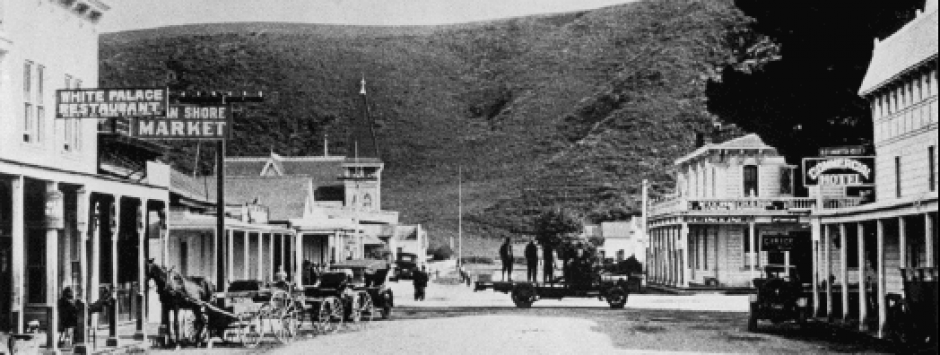
June 1980: Pescadero’s Flagpole Makes A Comeback

From “The Beachcomber: A Coastside Magazine,” June 3, 1981

Pescadero’s Flagpole Has Returned

By Charles Jones

If a town’s persistence can be chronicled by its dedication to a flagpole, Pescadero will last forever, and on its own terms. All the citizens of Pescadero own a piece of the pole set in place on May 22 of this year [1980.] It was not the first or most feisty pole setting in town.

Who had the idea to begin with, and even how the first flag pole got to town, is in some doubt. There are those who say the Native Sons of the Golden West first asked for the pole. And it has been written that Frank Bloomquist in Loma Mar brought out and donated the first pole, in 1916.

Most agree that was the year, but Billy Weeks used to say he cut the tree, a 131- foot pine. From 1916 to 1961 the pole stood in the center of the intersection of what is now Pescadero Creek Road and Stage Road. Weeks said it took two days to get the tree to Pescadero, and four men to put it up.

In 1961, when Pescadero Creek Road was being widened, it took San Mateo County engineers much less time than that to cut the pole down. The people of Pescadero were not amused. They were infuriated.

Determined not to lose the pole, the townspeople mounted a campaign to have the pole put somewhere near its familiar site of 45 years’ standing. The county suggested putting the pole at the high school, about a mile from town. Said one of the town’s leaders Earle Williamson, “They treat us like a bunch of hayseeds here. We’re sick of being pushed around.”

County supervisors, engineers, and other officials have learned that very thing in many ways since the “Great Flagpole Rebellion.”

Pescadero got its flagpole back, and the county put it where Pescadero wanted it. The same pole as replaced, off of Pescadero Creek Road, in the center of Stage Road By then John Rich was chairman of the Flagpole Committee. It was a victory for what one supervisor ill-advisedly called “the boondocks.” That does not happen any more.

Billy Weeks once said, “I didn’t like it a darn bit when they cut her down.” If he had still been alive in December, 1979, a few days before Christmas, he might have at least accepted what happened. In high winds, the pole fell, shattering the parking lot of what is now the post office. One could not say, as the county had in 1961, that “the flagpole has been temporarily removed and is being repainted.”

Nature has no such words to try to get out of its acts gracefully.

Fortunately, Pescadero had another Weeks, Ed, who is not, as far as he knows, related to Billy, but who family in the area goes back over a hundred years. Ed Weeks remembered a youth fund, started over 20 years ago by Peggy Olsen, for a swimming pool. The fund was there, had grown. Ed Weeks talked, he called, he got estimates and he began again to raise the Pescadero flagpole.

This time the 90-foot flagpole is fiberglass set in concrete. The golden orb, the flag, all is done. Continuing contributions over the $7000 cost will go toward flags and replacing the youth fund for some other project.

In town, patriots and cynics alike, agree that the flag gives a dandy dress to the town. What else could one want?

Well, perhaps a little swearing. When the flag and pole were officially dedicated–sworn, as it were, on May 30th, some might have thought, in the right spirit of the thing, Billy Weeks. He said, “One tme they asked me to make a speech about the pole. I told them I couldn’t make a speech without swearing in it.”

Comments off