Hi June,
It wasn’t my regular time off from my caregiving commitment, but with a little horsetrading I was able to use a few hours to zip out to the Native Sons Hall in Pescadero to attend a Pescadero History Club meeting this week. I was so glad I was able to bide-a-wee. Bide-a-wee is Scottish for “stay a while.” It was also the name of a paper published in Pescadero a hundred years ago. A group of attendees from the Dearborn area had a yellowed, fragmented copy of the “Pescadero Bideawee,” from October 23, 1909. It was so fragile it had been sealed in plastic to preserve it, but was basically intact. When it was passed around for viewing I took a few photographs of part of it, hoping I would have another chance to capture it completely. It is a treasure trove of ads for Pescadero businesses of that era along with some interesting stories. Despite searching online I could not find any reference to this newspaper. I’ll keep looking. Here’s a photographic tease until I get a chance to research it further, particularly with the folks that brought it. Enjoy. John.
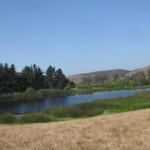
you will see the most spectacular views of the 150-year-old, 90-acre farm, plus next door you can see Jacobs Farm, an organic culinary herb farm (www.jacobsfarm.com).
You can book your wedding in this old long barn, stay overnight in the very authentic [& former cowboy’s quarters], tie the knot at the lake, and look out the barn window and see the natural wonders for yourself.
[You can visit Willowside Farms for a picnic and barn dance on Saturday, August 22, noon to 8 p.m. Leave your pets at home.]
Posted inUncategorized|Comments Off on Willowside Farms: When you look out this old barn window
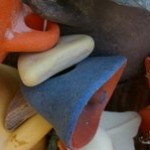
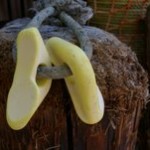
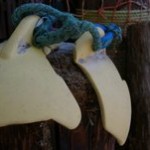
Here’s the story of a couple of unusual, but related types, of Non-buoyant Marine Debris that I collect. The first collection is as aptly named as the objects that comprise it were in their former lives. In that former life, they had performed what their name demands, under the harshest of conditions, often for many years, until after having been set free, they are transformed on our rugged coast and abandon their useful lives, even consequently their good and industrious name. I write of my Dontflotz collection.
A Dontflotz is the tethering hole, or the “Mickey Mouse Ears,” remnant of a hollow plastic fisheries float, after it is shattered against our rocky coast. And as its name suggests, once the float is broken, its pieces do not float. Instead, they move along the bottom, down the coast in the Longshore current, bashing on rocks here and there, losing their more delicate features. All the while, slowly being eroded, rounded, by the gentle brush of the “River of Sand,” as they make their interminable, silent procession towards a submarine canyon. Or my greedy little hands, if Neptune’s Vomitorium, will co-operate, and interrupt their march to obscurity, spitting them up at Invisible Beach.
The plastic floats that provide the source of my collection are some of the tough guy characters of the marine debris world. They are brute-rugged. They have no “glass chin” and when they were young contenders, looking for fame, they quickly knocked out the ex-champions that did, glass floats. Once freed of the exploitation of their harsh jobs, they rarely submit again to the fisherman’s dominance. Instead, they are frequently widely-travelled, with gooseneck barnacles testifying to their many years at sea.
Floating like us, metaphoric corks in the Sea of Life, moved by shifting confluences of the winds, waves and currents that form the North Pacific Sub-tropical Gyre, they pay their dues, often for many years, in one of nature’s harshest environment. They pass the days of their lives in the aptly named, Garbage Patch.
And when their end time comes, the West wind will blow, with strength and persistence, and they will begin their procession towards land. The Vellela Vellela will rush ahead, grounding themselves by the millions, as they herald the floats impending visit. Needless to say, I will be waiting for their and their Gyric retinue’s arrival on our coast, hoping to save as many of these gems from destruction as possible. To treat exotic visitors from Neptune’s kingdom otherwise, would be a serious breach of trust. But, if my hospitality efforts fall short, it’s good to know, another possible Dontflotz has been added to the huge collection waiting on the sea bottom offshore. Waiting for a chance to join those that have gone before them and been transmogrified to a heavenly Dontflotz. (note: Dontflotz is both singular and plural)
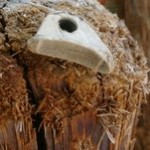
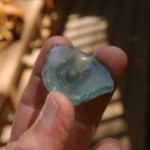
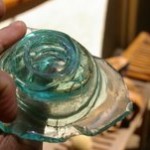
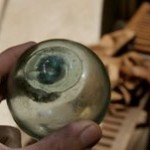
The second and related collection is even rarer thern Dontflotz. These odd objects, shown in the last attached photos, are the delicate remnants of the float world’s ex-champions. Those poor glass chin losers, pushed out of their noble fisheries professions by the hydrocarbon upstarts, are rarely seen on our coasts anymore. And our rocky shores are not friendly to their fragility, if they do show up. Thanks to Neptune’s Vomitorium I’ve found a few of their identifiable remnants, objects we call “Belly Buttons.” They are the thickest remnant of the gob of molten glass that the float was blown from, the spot the blow pipe is pulled from at the end of the blowing process, officially called the sealing button.
They come as “Innies and Outies,” but I’ve not seen one with a tether hole, as the floats were enclosed in netting, not tethered. My favorite “Belly Buttons,” not shown here, are as wonderfully polished as ancient sea glass. If you’re interested in learning more about glass floats, Wikipedia has a nice article, with pictures of the sealing button, their origins in Norway in the 1800s, subsequent worldwide use and an explanation of the episodic visits of these odd creatures to our shore. Enjoy. John
Posted inUncategorized|Comments Off on John Vonderlin: Dontflotz and Belly Buttons
I happened upon your website http://pescaderomemories.com/category/steele-family/ and I was hoping it is the same Steele family that I have been trying to find information on. I’m interested in possibly restoring “The Steele Family Mansion” located in Painesville, Ohio. It was built in the mid-1800’s and I would love to find the story behind it.
As of now I have found a few articles on Horace and G.W. Steele concering bank fraud in the late 1800’s and know that the house has changed hands twice since its fire in 2001 but still sits unoccupied and decaying.
If you have any information on the Steeles from Cleveland/Painesville or the home, I would love to hear it!
Thanks,
Shannon
Posted inUncategorized|Comments Off on Shannon Crusse: The Steele’s Family Mansion in Ohio…
It was 1897 and the “Klondike [gold] fever” was running strong at the Elk Horn Saloon on San Gregorio Street in Pescadero. This slice of social history was signed by F. B. Gardner.
“Jehiel C. Coburn, Eddie Armas, Joseph and Jerry Hollised, John McDonald and Frank Pinkham walked into Mr. Gianola’s El Horn Saloon. Two of the boys went to the bar and called for a ‘tin roof.’ Mr. Gianola was confused. He had never heard of a drink by that name.
“‘I can give you a Klondike,’ he said but the boys mixed the drink themselves.
“‘Now, said Gianola, ‘Why do you call that a tin roof?’
“‘Because it is on the house,’ said the boys. ‘Good day.'”
Posted inUncategorized|Comments Off on 1897: F.B. Gardner: Bartender says to the boys: “What’s a tin roof?”
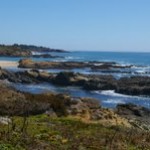
This first picture of a wonderfully rugged stretch of our coast is looking towards Bean Hollow Beach.
I just happened to stop here to document an easier path to Peacock Rock and the new arch, Iceplant Arch, I wrote about previously. I can’t think of a busier chunk of our coast as far as rocks, inlets, promontories, reef, etc, that is as easy to catch in one photograph as right here.
Having absorbed its complexity for a minute, I’m feeling a glow from the post-card-eye-candy aspects of the view. As I walk a little further towards the ocean, looking for a path down into the rock garden of tafoni and concretions, I see this:
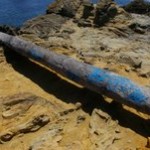
Grrr. What kind of nut would bring a spray can to a beautiful place and paint both the sign warning of poison oak and this huge log? In the big picture it is pretty small stuff. Teenage angst at their powerlessness? An overexuberant budding artist? A cry for recognition? Probably. Still its jarring, ugly intrusion into my glow had bummed me out. Somebody needs a good horsewhipping, I’m thinking. But, since I’m not sure if you can even do that to horses anymore, a hundred hours of community service as the “World’s Dirtiest Jobs” guy’s assistant is what I’m sure my Reptilian brain intended.
I hear you have had one of those “stupid crooks” events where young vandals do crimes and then post them on YouTube. In this case, I think it was the Pillarcitos Bridge they painted and Facebook where they posted their handiwork. I’d be curious if any of my graffitti photos are their “styles?” I’d love to add to their misery.
I expect the Graffitti guerillas will obscure the log’s graffitti soon, as it is so public. Enjoy. John
Posted inUncategorized|Comments Off on John Vonderlin Experiences Mood Altering Sights
Wow.
I just inadvertently stumbled across your website and found the article on San Gregorio Farms.
My name is Jordan Schwab (Son of Michael Schwab and Sandra Schwab)
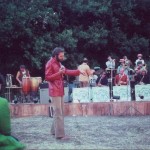
[Image below: Michael Schwab, Jordan’s dad, sings with the “Full Faith & Credit Band” during an event at San Gregorio Farms.]
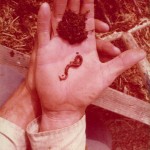
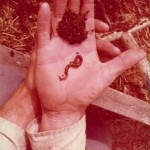
and I grew up in San Gregorio on the old worm farm and have intimate and first hand knowledge of the people involved there and the farm itself. I grew up with “uncle” Channing and would visit his house in Moss Beach regularly. I remember the General Store, the Greenpeace festivals put on by the Cattermole’s, and all of the eccentric characters that would hang around the area. If you have any knowledge of the farm, you may know that it was less a farm and more of a “spiritual” haven i suppose. I wouldn’t know where to start . . . it would fill a whole book. If you are ever interested in knowing more, I would love to share with you the very unique and priviledged perpective I had growing up there.
Cool website by the way, It hit me with such a wave of nostalgia that i’m still reeling,
Posted inUncategorized|Comments Off on Jordan Schwab Remembers San Gregorio’s Worm Farm
[Image below: Meet Hillary, one of the resident guard dogs.]
I took my cousin, Gabriele, with me, and we had a fabulous tour of historic Willowside Farm, and I cannot rave enough about it! We were invited to a geese, duck and sheep-herding (national championship) event oh, so calming, so relaxing. The participants, mostly ladies, were just perfect hosts. I cannot remember when I had a more relaxing time.
You should know that Wilowside is an historic dairy, originally owned in the 1860s (something like that, or earlier, even—and certainly, the land could have been occupied by adventurous settlers before the Gold Rush in 1849) by Pescadero’s pioneer Alexander Moore family. In brief, there were a series of owners but the bottom line is: Willowside was built, and demonstrates today, that it was constructed as a “big time” dairy and showplace. The buildings on the property, and there are many, have been brought up to code comply with the current, rigorous standards of the County of San Mateo. There’s no choice about that kind of thing—I saw earthquake standards put in place in old structures— I recognized them because I have them in my own home.
Willowside Farm manager Michael Head, a former Marine, impressed me so much. He has been working on resurrecting the farm’s original dignity for a dozen years—this is a man who is the best. My cousin and I could not believe that he had accomplished what he had. Fixing up the property was an immense project, more than any of us “mere mortals” could ever tackle. What a man!
And, now, one of the big long barns will be used for events and weddings, with the nupitals performed at a nearby lake, so dreamy lake you will never want to leave.
Right now there are rustic accommodations (the former quarters for the cowboys, including circa 1950s handwritten “graffiti” on the bathroom door!) for overnight guests: I may not be accurate on the cost, but i think Michael said something like $60 bucks a night for a room in a place that has no equal on the Coastside. I mean, if you want ruggedness, if you want to experience the way it was, try one of the guest rooms. Very authentic.
I understand that, in the near future, “Outstanding in its Field” is doing a wedding at the dairy. Wow. I look forward to hearing about one of their lunches or dinners there.
I know, I know. The South Coast. The last frontier on the Coastisde—but this is worth it. The owner, and the managers, Michael Head and his wife, Julie Sittig have taken, perhaps one of the most special properties on the South Coast, and turned it into a treasure that will soon be known all over the world.
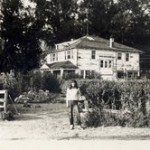
(In fact, Michael told me that someone took a photo of the main blue and white trimmed house, and was selling it as a postcard of an authentic old place to stay overnight in France.)
Michael pointed out a “Dawn” redwood
which is fringy-ier than the usual redwoods we are accustomed to seeing here on the Coastside. In the 1970s the “Dawn” redwood caused excitement when the same tree was found growing in China.
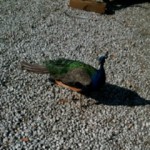
Willowside Farm has used a flock of cats as enforcers to move out the rats and other undesirable critters. And there are peacocks everywhere; the males display the full spectrum of color
while nature has protected the females with a neutral look so as they protect their young on the ground. When we were visiting, we saw baby peacocks trailing behind the mom, the color of “invisible.”
I applaud you: Willowide Farms.
(This was written off the cuff; I was excited by what I saw. Sad to hear that “sticky fingers” took so much from the old Willowside, authentic relics, irreplaceable, but so much history remains for all to enjoy along Stage Road…….)
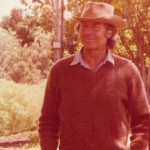
[Image above, circa 1980. Me standing in front of Willowside Farms, photo by Suzanne Meek.]
[[Note: Local artist/photographer Susan Friedman produced a documentary on Alice Mattei before she died and the property was sold. The doc gave an accurate picture of how the dairy worked, the work ethic of the Matteis, and how everyone in Pescadero attended the parties there.] Also, above photo of Hillary, a “guard dog”, was shot with the new iPhone. It’s amazing what the new iPhone photo can do close-up. Not bad, huh?” Oh, and that’s my shoe in the picture!]
————————–
*And don’t forget*
3rd Annual Willowside Ranch PICNIC & BARN DANCE
Saturday, 22nd August from noon – 8:00 pm
2400 Stage Rd. Pescadero
EATING, DRINKING, MUSIC & DANCING
with SAXYMAN & THE LADDS
There will be hotdogs, hamburgers, vegiburgers & sodas.
Bring you favorite side dish &/or something that you like to drink to share .
Posted inMichael Head, Willowside Dairy|Comments Off on Willowside Farm: Where Dogs are the BEST & you can stay overnight in the most rustic, original place on the South Coast!!!!
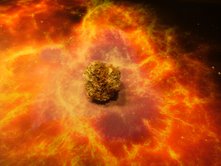
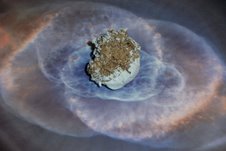
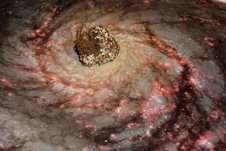
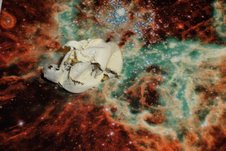
I checked out a new book from my library entitled, “Hubble Imaging Space and Time.” It’s a great coffee table book with lots of excellent. awe-inspiring photos, and a comprehensive insider history of the Hubble Space Telescope project. When I was looking at various pictures of the now famous “Eagle Nebula,” whose pictures were plastered all over the media in 1995, and revolutionized Space photography, I realized it would be a great background for close-ups of some of the golfball remnants I collected this year. Though Neptune’s Vomitorium has been quite unproductive this year, every once in a while it spit out a golfball or two. Some of them quite old and fantastically eroded as this one.
Posted inUncategorized|Comments Off on From John Vonderlin’s New Camera: “Golf Balls in Outer Space”
“Finding of a small trawler, pounding itself to pieces on the rocks near Ano Nuevo Island, off the Pescadero coast, today, led to expressions of grave fears for the safety of the crew of the boat. The trawler apparently struck the rocks some time during the past week, and by today had been battered into splinters. So far no identification of ownership has been made by those investigating. No trace whatever of the crew of the trawler has been obtained. Conflicting rumors concerning the finding of the boat have spread here, principally involving a supposed fatal trip of rum runners along the coast, with the probable washing overboard of the crew and cargo., if such things did take place, by the treacherous seas along the coast here. There have been numerous incidents of late, it is stated, revealing that rum runners unfamiliar with the handling of boats have been meeting with disaster in the heavy seas.”
—–
“Pescadero’s mystery ship which has been pounding itself to pieces on the rocks off Ano Nuevo Island, was today identified as the ‘SS Fremont,’ rum running vessel which struck the rocks January 4, it was stated this morning. The wreck of the ‘Fremont’ occurred, it is said, when the pilot of the craft mistook the light on Ano Nuevo Island for the light on ‘Mile Rock,’ which is the signal to turn east for entry into the Golden Gate. One life was lost.”
Posted inUncategorized|Comments Off on 1924: Crew Missing as Boat Hits Island Rocks
 Story by John Vonderlin
 and would visit his house in Moss Beach regularly. I remember the General Store, the Greenpeace festivals put on by the Cattermole’s, and all of the eccentric characters that would hang around the area. If you have any knowledge of the farm, you may know that it was less a farm and more of a “spiritual” haven i suppose. I wouldn’t know where to start . . . it would fill a whole book. If you are ever interested in knowing more, I would love to share with you the very unique and priviledged perpective I had growing up there.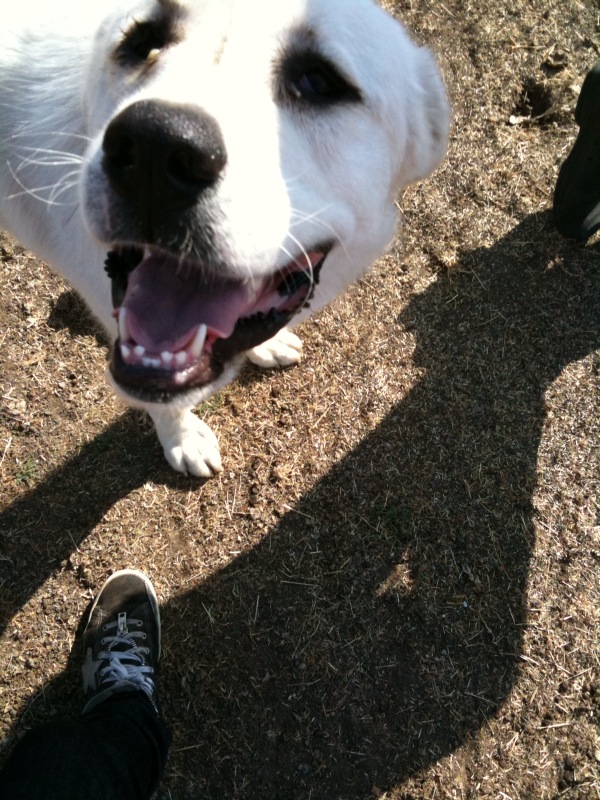
 oh, so calming, so relaxing. The participants, mostly ladies, were just perfect hosts. I cannot remember when I had a more relaxing time.
 will be used for events and weddings, with the nupitals performed at a nearby lake, so dreamy lake
  you will never want to leave.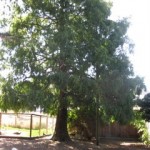
 Story/Images from John Vonderlin